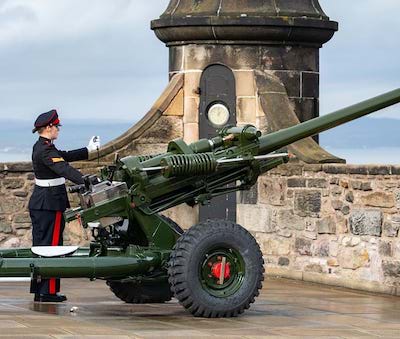
The One O’Clock Gun is a time signal fired at 1pm (13:00 hrs) from a field gun at Edinburgh Castle. The gun is fired every day except on Sundays, Good Friday and Christmas Day.
The gun itself is a 105mm army field gun. This gun has been used since 2001 when it replaced a 64 pounder gun.
The firing of the gun is very loud and can certainly make you jump if you’ve never heard it before. But why is it fired everyday? And why is it fired at 1 o’clock?
Why Is The One O’Clock Gun Fired?
Traditionally, the one o’clock gun has been fired to tell crews on ships in the River Forth that it’s one o’clock and therefore it’s time to reset your chronometer. But the story of the one o’clock gun is more interesting than just telling the time. And to find the origins of the one o’clock gun, we need to go back to the nineteenth century and understand why telling sailors the time was important.
Longitude and the Nelson Monument
On a ship, knowing where you are when you’re in the middle of the ocean is naturally very important. To know where you are, you need to know two things: latitude and longitude. Latitude tells the north-south position, and is easy to calculate by using the position of the sun. Longitude tells the east-west position and is not all easy to calculate.
It wasn’t until the chronometer was invented in the middle of the 18th century that it made measuring longitude scientifically accurate. To measure your east-west position you must calculate your time to an absolute measure of time. The measure of time used was Greenwich time.
But it was important that ships’ chronometers were kept calibrated, as being at the wrong time could have serious consequences when out at sea. When ships were in port therefore they would recalibrate or reset the chronometer.
To do this while docked at Edinburgh’s port of Leith, or even in while sailing in the River Forth, all the captain needed to do was look toward Edinburgh and the top of the Nelson Monument on Calton Hill. On the top of the Nelson Monument is a time ball, a great ball weighing 90kg (15cwt) that slowly rises to the top of the monument every day just before one o’clock.
The great ball hangs there for a few seconds then, on the stroke of one, it drops, indicating that it’s one o’clock and time to reset your chronometer.
The Problem Of Fog
Looking at the Nelson Monument time ball was all very well, but what if it was foggy? And it sometimes gets very foggy out on the firth of Forth.
The Nelson Monument is 561ft (171m) above sea level as it’s built on top of the Calton Hill, and the height of the monument itself added another 105 ft (32m) to the height, which means even on misty days, the ball would be unable to be seen, rendering it useless as a time signal.
At this point, John Hewitt, and Edinburgh businessman, proposed a solution – firing a gun.
Hewitt had seen (or heard) the time gun on a visit to Paris in 1846. Strolling in the Jardin du Palais-Royal, he heard the little gun go off at 1pm and promptly decided that Edinburgh should have an audible time signal also.
When Hewitt returned to Scotland, he lobbied the council for a time gun to be fired in Edinburgh but was pretty much ignored and it wasn’t until Charles Piazzi Smyth, the new, young Astronomer Royal for Scotland heard of the idea that things began to happen.
It was Piazzi Smyth who had had the time ball installed in the Nelson Monument in 1852 and by 1861 it was obvious that an audible signal was also required for those murky foggy days that Edinburgh and the River Forth experience so often. And so the one o’clock gun was born and John Hewitt finally got his wish.
The First Firing Of The One O’Clock Gun
Today, the timing of the firing of the one o’clock gun is controlled by digital technology. But in 1861, all they had were clocks. In addition, the gun had to be fired at the same time as the time ball on the Nelson Monument was dropped. How was this achieved?
The timing of the dropping of the time ball at the top of the Nelson Monument was controlled from the nearby Royal Observatory on the hill. Therefore the firing of the gun would also need to be controlled by the Royal Observatory to ensure synchronicity with the time and with the time ball.
When Charles Piazzi Smyth considered the problem, he came with what you might call the obvious solution. He would run a cable all the way from the Calton Hill to Edinburgh Castle, from where the gun would be fired.
And that’s exactly what he did. He employed sailors of ships anchored at Leith Docks to run a cable from Calton Hill across the city centre to Edinburgh Castle and up to the Half Moon Battery where the gun was situated. At 4,200 ft (1,280m) long, it was by far the longest cable in Scotland.
(In 1873, it was found that the enormous strain of holding the cable was causing damage to the Nelson Monument. To take some of the strain off the monument, it was attached to four intermediate anchors along the route, at the Old Post Office on Waterloo Place, the New Post Office at the bottom of the North Bridge, St. Giles Cathedral in the Royal Mile and the steeple of the Highland Tolbooth Church on the Lawnmarket.)
When everything was connected, the cable would then operate a trigger to fire the gun at precisely one o’clock and the stage was set for the first firing of the gun on June 5, 1861.
On the day, an invited audience of over 300 people crowded around the Royal Observatory on Calton Hill to watch the time ball drop and then listen for the sound of the gun being fired from the castle.
At one o’clock, the time ball dropped as usual and everyone then strained their ears and looked toward the castle for the flash of smoke from the gun, but nothing happened.
It seems that even in the 19th century they experienced problems at the first demonstration of new technology. Everyone was invited back the following day when engineers would have found and fixed the problem.
The problem turned out to be faulty detonator in the cannon and on June 6, the One O’Clock Gun was fired for the first time and has fired at one o’clock ever since.
Sound And Vision for Time
Augmenting the visual signal of the time ball with a roar of a cannon firing was a good idea. After all, whether it was foggy or not, sound would always be heard.
But there is a huge difference between the speed of sound and the speed of light. You could see instantly when the time ball dropped but the sound of the gun firing would take some time to reach the River Forth from Edinburgh Castle.
Relying on the sound alone to signal one o’clock would mean that the actual time would be one o’clock and some seconds. And for ships calibrating chronometers, the disparity meant that the chronometers would not be as accurate as they needed to be.
However, as you might expect, Piazzi Smyth had anticipated this (he was an astronomer after all) and he developed a ‘sound map’ that showed a map of Edinburgh overlaid with a series of concentric circles.
Each circle on the map represented one second delay in the sound reaching that part of Edinburgh. In order to calculate the time delay you simply counted the circles to where you were in the city. According to the sound map, it takes six seconds for sound to travel from Edinburgh Castle to the harbour at Leith and about 10.5 seconds if your ship was in the middle of the Firth of Forth.
This enabled sailors on ships docked at the port to know accurately that hearing the one o’clock gun meant that the actual time was one o’clock and six seconds.
When the One O’Clock Was Fired In Anger
Has the one o’clock gun ever been fired for real? The strange answer to this actually yes it has.
Obviously, the one o’clock doesn’t actually fire any projectile. There’s no cannon ball or shell in the gun. But in 1916, the gun was fired at German zeppelins that were bombing the city.
One April 2 1916, Zepplins L14 and L22 bombed the city, killing 13 civilians. As the Zeppelins moved across the city, the One O’Clock gun was brought into action for the first and only time.
It fired at the airships but was very unlikely to have caused any damage because it fired only blanks. It’s thought that the gun was fired to try to drive the Zeppelins off.
Who Fires The One O’Clock Gun?
The gun is fired by a volunteer District Gunner from Edinburgh’s 105th Regiment Royal Artillery. Many of the gunners have held the post for a long time.
The most famous and longest serving gunner was Staff Sergeant Thomas McKay. He was nicknamed ‘Tam the Gun’ and held the post for 26 years, from 1979 to 2005. When he died a railway locomotive, Class 91 locomotive, No.91122 was named Tam The Gun after him.
Taking over from Sergeant McKay was Sergeant James Shannon, who held the post until 2012. Sergeant MacKay also had a gun nickname – he was known as ’Shannon the Cannon’.
The first woman to fire the one o’clock gun was Bombardier Allison Jones in 2006.