If you’re travelling to Edinburgh, you can use all available modes of transport to get here. You can get to Edinburgh directly by plane, or by train, bus or car from anywhere in Europe via the Channel Tunnel. Travelling by boat involves onward land transport from the port.
Get to Edinburgh by Plane – Travel directly to Edinburgh Airport
Get to Edinburgh by Train – Travel directly to Edinburgh main railway station, Waverley
Get to Edinburgh by Bus – Travel directly to Edinburgh Bus Station
Get to Edinburgh by Boat or Ferry – Travel to one of the many ferry ports in England, then by bus or train to Edinburgh
Get to Edinburgh by Car – Travel directly to Edinburgh from all over Europe
How To Get To Edinburgh – By Plane
Edinburgh Airport, code EDI, is an international airport with flights arriving from countries all over the world. Most international arrivals are from hub airports, mostly Amsterdam and London Heathrow. The Edinburgh leg of your journey from either Amsterdam or London will take about one hour.
- From the USA, Canada and South America: Fly to Amsterdam or London Heathrow and onwards to Edinburgh.
- From Europe and Russia: Fly directly or via Amsterdam
- From Ireland: Fly directly from Dublin
- From the Baltic States and Scandinavia: Fly directly or via Amsterdam
- From Australasia and Asia: Fly to Amsterdam or London Heathrow and onwards to Edinburgh.
How To Get To Edinburgh From The Airport
The easiest and simplest way to get to Edinburgh from the airport is by public transport. Use the tram or the bus. The bus and tram stops are directly outside the main terminal building. Taxis (black cabs) are also available. The taxi rank is situated across from the main terminal building in the car park.
By Tram (Fare £6.50, child £3.30)
The tram takes 37 minutes to the centre of Edinburgh. Your stop there will be St Andrew’s Square. The square is in the middle of the city where taxis or buses will take you to your final destination. The fare is £6.50 for adults, £3.30 for children (5-15) and is free for children under 5. If you’re returning to Edinburgh Airport, a return family ticket for 2 adults and up to 3 children costs £22.50.
By Airport Bus (Fare £4.50, child £2.00)
The airport bus (service 100) is slightly quicker than the tram. It will take you to St Andrew’s Square in 30 minutes. The square is in the middle of the city where taxis or buses will take you to your final destination. The fare is £4.50 for adults, £2.00 for children (5-15) and is free for children under 5.
By Taxi (Fare £20.00 approx)
A taxi (black cab) from the airport to the city centre will cost approximately £20. Taxis take up to 5 people
By Hire Car
From the terminal building, cross to the car park and follow the signs for the Car Rental Centre.
What Is Edinburgh Gateway?
Edinburgh Gateway is the railway station that serves Edinburgh Airport. The Gateway station serves destinations all over Scotland, which means you can catch a train there and avoid going into Edinburgh city centre.
The Gateway station is about 20 minutes from the airport and is served by tram, bus (service 100) and taxi.
However, if you are travelling from Edinburgh Airport to Glasgow and the west of Scotland by train, it’s easier to take the tram or bus to Haymarket Station and catch the Glasgow train from there. This will save changing from the tram or bus at Gateway, then changing again at Haymarket for the Glasgow train.
How To Get To Edinburgh – By Train
You can travel to Edinburgh by train from all over Europe via the Channel Tunnel to London. Travelling by train from London to Edinburgh takes around five hours or less, depending on which service you take.
- From countries across Europe, take the Eurostar from Brussels, Amsterdam, Paris or Lille to London St Pancras station. Change at St Pancras for King’s Cross and the train to Edinburgh. It’s about a five minute walk between St Pancras and King’s Cross stations.
- From London: Take the direct train from London King’s Cross station. There are around 14 trains a day to Edinburgh. The Flying Scotsman is the fastest, taking only 4 hours 35 minutes to reach Edinburgh, with just one stop at Newcastle.
- From Ireland: Take the ferry from Dublin to Holyhead in Wales. The ferry port and the train station share the same building, so changing to the train on arrival at Holyhead is easy. You will need to change trains at least once from Holyhead to Edinburgh, usually at Crewe. Average travel time from Holyhead to Edinburgh is 5 hours 23 minutes.
Arriving In Edinburgh By Train
You will arrive at the main station, called Waverley, just off Princes Street in the very heart of the city. The bus station and tram stop are a five minute walk away. City buses and taxis will take you to your final destination.
How To Get To Edinburgh – By Bus
You can travel to Edinburgh by bus from all over Europe via the Channel Tunnel to London. Travelling by bus from London to Edinburgh takes around 11 hours but there are some faster services.
- From countries across Europe, the bus arrives at London’s Victoria Coach Station. From there you can catch the bus to Edinburgh
- From London: Take the direct bus from London Victoria Coach Station. National Express and Megabus provide around 20 services a day to Edinburgh, with the fastest service getting to Edinburgh in 8 hours 35 minutes.
- From Ireland: There’s no good way of travelling by bus from Holyhead to Ferry. The best upon arriving at the port is to take the train. The ferry port and the train station share the same building, so changing to the train on arrival at Holyhead is simple. You will need to change trains at least once from Holyhead to Edinburgh, usually at Crewe. Average travel time from Holyhead is 5 hours 23 minutes
Arriving In Edinburgh By Bus
You will arrive at Edinburgh bus station, located in St Andrew’s Square in the heart of the city. The bus station is a five minute walk to the main railway station and a one minute walk to the tram stop.
How To Get To Edinburgh – By Car
Driving to Edinburgh from anywhere in Europe is easy. Simply drive to Calais in France and catch the Eurotunnel Le Shuttle to England. The shuttle takes 35 minutes to reach Folkestone.
On arrival at Folkestone, you’ll drive off the shuttle and onto the M20 motorway. Driving non-stop, it will take at least 8 hours 30 minutes but be prepared for delays as the motorway system in England can get very busy.
- From countries across Europe, drive directly via the channel tunnel and take either the M20/M11/M1/A1 route or the M20/M1/M6/M74 route to Edinburgh.
- From Ireland: Take the ferry from Dublin to Holyhead in Wales. Then take the A55/M6/M74 route to Edinburgh. It will take around 6 hours, depending on traffic.
Arriving In Edinburgh By Car
There are two main routes into Scotland from the south. The M6/M74 enters Scotland from the south west, while the M1/A1 route enters Scotland from the south east. Both routes converge on the A720 Edinburgh City Bypass before arriving in to the city and Edinburgh and its districts are well signposted.
How To Travel In Edinburgh
Once you’ve arrived in Edinburgh, you’ll find that getting around the city is easy – apart from driving! Edinburgh is a fairly small city, so walking is a great way to see the sights. Cycling is also a good way to travel in Edinburgh, although you will need to navigate some steep hills! City buses are cheap and frequent.
How To Drive In Edinburgh
Drive on the left! Like many modern European cities, Edinburgh isn’t a great place in which to drive. It’s busy, and many of the streets are narrow and one-way which means that you need to plan your routes carefully.
Roundabouts are a feature of Edinburgh streets as well, so if you’ve no or little experience of roundabouts, take it easy, especially if, like most foreign visitors, you normally drive on the right.
Also, take your time. Drive slowly and carefully in the city centre. Speed limits in the city are mostly 20 miles per hour (32 kph).
How To Park In Edinburgh
Parking in Edinburgh is expensive and street parking places are hard to find. Edinburgh Council is continually removing street parking places to make way for cycle lanes or to extend the width of pavements, so the number of street parking places is reducing.
Street parking charges vary from £5.00 an hour downwards, depending on where in the city you’re parking. The on-street parking machines will guide you as to the cost per hour and how long you’re permitted to park. Most street places, especially in the city centre, restrict parking to 4 hours. In the centre of the city, parking charges operate six days a week, with Sunday free. Always check the parking machines however, as Edinburgh Council will introduce Sunday parking charges later in 2021.
Another thing to watch out for, especially in Edinburgh’s New Town but also in the suburbs, some on-street parking is designated ‘Resident Parking Only’. This means that only people who live in the street and have paid for a permit can park there. The exception to this is on Sundays, where anyone can park in Resident Parking spaces.
Pay for parking with coins, credit or debit card or with an app called Ringo, which can be downloaded from the App Store or Google Play.
With on-street car parking scarce, consider parking in a multi-storey car park. There are eight in the city. These are:
- Blackfriars Street – EH1 1TH ( provided by Raddison Blu )
- Castle Terrace – EH1 2EN ( provided by NCP )
- Fountain Park – EH11 1AF ( provided by Land Securities )
- Omni Centre – EH1 3AN ( provided by Q-Park )
- Quartermile – EH3 9AU ( provided by Q-Park )
- Holyrood Road – EH8 9UL ( provided by NCP )
- St Mary’s Street – EH1 1TA ( provided by Apcoa )
- Waverley Station – EH1 1BB ( provided by Apcoa )
Travelling By Bus In Edinburgh
Edinburgh buses are easy to use, are frequent , and are a great way to get around. Lothian Buses is the main bus operator and provide travel around Edinburgh and the outskirts for a single flat fare. Check their website for the current fare.
Pay for bus fares with coin, credit or debit card or with a bus pass.
- No change is given on buses, so if you’re paying with coins, use the correct amount.
- Paying with credit or debit card is easier and cheaper. Just tap your card on the payment machine, which is situated beside the driver. You’ll be charged one single fare for each tap, but charges are automatically capped if you use the bus for three journeys or more in a single day (remember you need to tap your card every time you board the bus, even if you’re on your fourth or greater journey)
- Pay with a Ridacard season ticket. If you’re in Edinburgh for a week or more and expect to take more than 11 bus journeys throughout the week, a Ridacard is the best value and is easy to use. A Ridacard is valid for use on all day buses, night buses, trams and airport buses. Check Lothian Buses website for how to purchase.
Travelling By Bike In Edinburgh
Edinburgh city centre is very busy so be careful when you’re cycling on the streets. However, the Council has been building cycle lanes throughout the city so use these when you can.
However, there are many cycling and walking routes through the centre of Edinburgh that are off-street. Mostly these are old, disused railway lines that have been converted to cycleways and are very pleasant for cycling. See the website, http://cycling-edinburgh.org.uk for great information on Edinburgh cycleways. The website, https://sustrans.org.uk lists some great cycle routes in and around Edinburgh.
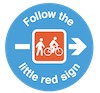
There are street signs like this one all over Edinburgh and beyond that will guide you along the National Cycle Paths.
Hiring A Bike In Edinburgh
Hiring or renting a bike is easy in Edinburgh. There are two ways to hire a bike:
- go to a bike shop where you can choose from many different kinds of bike and get helmets, lights and locks
- simply pick up a self-hire bike at over 70 locations around the city.
Hiring a bike from a bike shop is best if you’re planning on a cycling day or a cycling holiday. The staff in the bike hire shops are all cyclists and will give you great advice as well as help you choose the right bike for your needs. Check out these four shops:
- Biketrax
- Pedal Forth
- Cycle Scotland
- Leith Cycle Company.